1. A ball is projected upward at a certain angle with the horizontal .which of the following statement is/are correct. At highest point
a. velocity of the projectile is not zero
b. acceleration of the projectile is zero
c. velocity of the projectile is along the horizontal direction
d. Acceleration of the projectile is vertically upwards
2.which one of the following statement is correct?
a. A body has constant speed but varying velocity
b. A body has constant speed but varying acceleration
c. A body having constant speed cannot have acceleration
d. None of the above
3.which of the following remains constant durng the motion of the projectile fired from a planet
a. KE
b. Momentum
c. Vertical component of the velocity
d. Horizontal component of the velocity
4.what is wrong for a body having uniform circular motion?
a. Speed of the body is constant
b. Acceleration is directed towards the centre
c. Velocity and Acceleration vector are having an angle 45
d. none of the above
5.A body moves along a semicircular track of Radius R.Which of the following statement is true
a. Displacement of the body is 2R
b Distance travelled by the body is πR
c Displacement of the body is πR
d none of the above
6.which of the following is false
a. The speed of the particle at any instant is given by the slope of the displacement-time graph
b. The distance moved by the particle in a time interval from t1 to t2 is given by the area under the velocity -time graph during that time interval
c. Magnitude of the acceleration of the particle at any instant is given by the slope of the velocity time graph
d none of the above
7. A particle is going moving along x-axis.which of the following statement is false
a. At time t1 (dx/dt)t=t1=0,then (d2x/dt2)t=t1=0
b.At time t1 (dx/dt)t=t1 < 0 then the particle is directed towards origin
c.if the velocty is zero for a time interval ,the acceleration is zero at any instant with in the time interval.
d. At time t1 (d2x/dt2)t=t1 < 0 then the particle is directed towards origin
8.A particle starts at time t=0 from x=0 along the positive x-axis with constant speed v .After time t,it return back towards the orgin with the speed 2v and reaches the origin in t/2 sec .Which of the following is true for the whole process
a. Average velocity is zero for the whole process
b Average speed is 4/3v for the whole process
c.Displacment at time t is equal to vt
d. Displacment at time 3t/2 is 2vt
9. The range of the projectile depends upon
a. Angle of the projection
b. Acceleration due to gravity
c. Mass of the projectile
d. The magnitude of the velocity of projection
10. Two bullets A and B are fired horizontally with speed v and 2v respectively.which of the following is true
a. Both will reach the ground in Same time
b. Bullet with speed 2v will cover more horizontal distance on the groud
c.B will reach the ground in less time then A
d. A will reach the ground in less time then B
Solutions
Showing posts with label Motion in a Plane. Show all posts
Showing posts with label Motion in a Plane. Show all posts
Wednesday, 31 March 2010

Saturday, 26 July 2008
Problem Solving tips for IITJEE Mechanics
Vector Mathematics
You will come across vectors in physics problem very frequently.So it is must to know to solve the vector mathematics in short time.And Making sure you have done in correctly.You will find vectors in every module be it mechanics ,electrostatics,magentics
Addition or Substraction
When you need to add or substract two or more vectors, you can use following procedure
1. Select a coordinate system that is convenient. (Try to reduce the number of
components you need to find by choosing axes that line up with as many
vectors as possible.)
2. Draw a labeled sketch of the vectors described in the problem.
3. Find the x and y components of all vectors
4. Compute the resultants in x and y direction
5. If necessary, use the Pythagorean theorem to find the magnitude of the resultant vector and select a suitable trigonometric function to find the angle
that the resultant vector makes with the x axis.
Products
When u need to perform scalar or vector product.It is nice to following procedure
1. Select a coordinate system(x,y,z) that is convenient. (Try to reduce the number of
components you need to find by choosing axes that line up with as many
vectors as possible.).Use i,j,k as the unit vector across x,y,z axis.
2. Draw a labeled sketch of the vectors described in the problem.
3. Express all the vector in form in i,j,k forms
4. Perform the multipication
Motion in a Two dimensional Plane
- Select a coordinate system and resolve the initial velocity vector into x and y
components.
-Find out acceleration in each direction and solve in each direction according to one rectilinear motion equation.
-if the acceleration is in vertical direction only.Follow the techniques for solving constant-velocity problems to analyze the horizontal motion. Follow the techniques for solving constant-acceleration problems to analyze the vertical motion. The x and y motions share the same time of flight t.
- There might be question about trajortory in the Problem ,find out the motion in x and y direction with respect to time from previous point.And then find the value of t from one equation and then put that value in another equation to find out the equation of trajactory
Motion in a Three dimensional Plane
- Select a coordinate system and resolve the initial velocity vector into x , y and z components
-Find out acceleration in each direction and solve in each direction according to one rectilinear motion equation.
Uniform Circular Motion
-Draw a simple, neat diagram of the system.
-Firstly consider the origin of the forces acting on the each object.To do this find out the field forces acting on the each object.Wherever contact in available account the contact force carefully
-Find out the force acting on the body.The resultant force should provide the required centrepatal required for Circular motion
-Centrepatal force=mv2/R will give the velotiy accordingly.
Newtons Law Problem
-Draw a neat diagram of the system.
-Firstly consider the origin of the forces acting on the each object.To do this find out the field forces acting on the each object.Wherever contact in available account the contact force carefully
-Isolate the body whose motion is to be analyzed. Draw a free-body diagram for this body. For systems containing more than one objects, draw separate free-body diagrams for each objects This way there will not any confusion about the force acting on each object.Newtons Third law will help in obtaining the action reaction pair. Do not include in the free-body diagram forces exerted by the object on its surroundings. Establish convenient coordinate axes for each objects and find the components of the forces along these axes.
- Use pseudo force if viewing from the non intertial frame of refrence
-Apply Newton's second law, F= ma, in component form.
-Solve the component equations for the unknowns. Remember that you must have as many independent equations as you have unknowns to obtain acomplete solution.
-Make sure your results are consistent with the free-body diagram.
- If the object are attached to each others by the strings,then make use of constraints theory to find out the acceleration equation between the objects
Work And Energy
- Choose your frame of refrence.KE will differ in each refrence frame while PE will remains constant
-Define your system, which may include two or more interacting particles, as well as springs or other systems in which elastic potential energy can bestored. Choose the initial and final points.
-Identify zero points for potential energy (both gravitational and spring). If there is more than one conservative force, write an expression for the potential energy associated with each force.
-Determine whether any nonconservative forces are present. Remember that if friction or air resistance is present, mechanical energy is not conserved.
-Determine whether any external forces are present. Remember that external forces are present, mechanical energy is not conserved.
-If mechanical energy is conserved, you can write the total initial energy at some point Ei=PEi+KEi. Then, write an expression for the total final energy at the final point that is of interest Ef=PEf+KEf. Because mechanical
energy is conserved, you can equate the two total energies and solve for the quantity that is unknown.
-If frictional forces are present (and thus mechanical energy is not conserved), first write expressions for the total initial and total final energies. In this case, the difference between the total final mechanical energy and the total initial mechanical energy equals the change in mechanical energy in the system
due to friction.
-If external forces are present (and thus mechanical energy is not conserved), first write expressions for the total initial and total final energies. In this case, the difference between the total final mechanical energy and the total initial mechanical energy equals the change in mechanical energy in the system
due to external force.
-If both external forces and frictional forces are present (and thus mechanical energy is not conserved), first write expressions for the total initial and total final energies. In this case, the difference between the total final mechanical energy and the total initial mechanical energy equals the change in mechanical energy in the system due to external force and friction
Momentum and Collisions
- Choose your frame of refrence
-Set up a coordinate system and define your velocities with respect to that system.It is usually convenient to have the x axis coincide with one of the initial velocities.
-In your sketch of the coordinate system, draw and label all velocity vectors and include all the given information.
-Write expressions for the x and y components of the momentum of each object before and after the collision. Remember to include the appropriate signs for the components of the velocity vectors.
-Write expressions for the total momentum in the x direction before and after
the collision and equate the two. Repeat this procedure for the total momentum
in the y direction. These steps follow from the fact that, because the momentum of the system is conserved in any collision(law on conservation of linear momentum), the total momentum along any direction must also be constant. Remember, it is the momentum of the system that is constant, not the momentan of the individual objects.
-If the collision is inelastic, kinetic energy is not conserved, and additional information is probably required. If the collision is perfectly inelastic, the final velocities of the two objects are equal. Solve the momentum equations for the unknown quantities.
-If the collision is elastic, kinetic energy is conserved, and you can equate the
total kinetic energy before the collision to the total kinetic energy after the
collision to get an additional relationship between the velocities.And you can solve the energy and momentum equation to find out the find velocities.
- Centre of mass can be useful feature in solving the momentum problems
Body in Static equilibrium
-Draw a neat diagram of the system.
-Firstly consider the origin of the forces acting on the each object.To do this find out the field forces acting on the each object.Wherever contact in available account the contact force carefully
-Isolate the object being analyzed. Draw a free-body diagram and then show
and label all external forces acting on the object, indicating where those forces are applied.This way there will not any confusion about the force acting on each object.Newtons Third law will help in obtaining the action reaction pair. Do not include forces exerted by the object on its surroundings.(For systems that contain more than one object, draw a separate free-body diagram for each one.) Try to guess the correct direction for each force. If the direction you select leads to a negative force, do not be alarmed; this merely means that the direction of the force is the opposite of what you guessed.
-Establish a convenient coordinate system for the object and find the components of the forces along the two axes. Then apply the first condition for equilibrium. Remember to keep track of the signs of all force components.
-Choose a convenient axis for calculating the net torque on the object. Remember that the choice of origin for the torque equation is arbitrary; therefore, choose an origin that simplifies your calculation as much as possible.
Note that a force that acts along a line passing through the point chosen as
the origin gives zero contribution to the torque and thus can be ignored.
Saturday, 15 March 2008
Graphical Question for Kinematics
1. A ball is dropped vertically from a height h above the ground .It hits the ground and bounces up vertically to a height h/2.Neglecting subsequent motion and air resistance ,its velocity v varies with the height h as


2. The displacement -time graph of a moving particle is shown below.The instantanous velocity of the particle is negative at the point

a. C
b. D
c. B
d. A
3.The velocity -time graph of a moving particle is shown below.Total displacement of the particle during the time interval when there is nonzero acceleration and retardation is

a. 60m
b. 40m
c. 50m
d. 30m
4. Figure below shows the displacement -time graph of two particles.Mark the correct statement about their relative velocity

a. It first increases and then decreases
b. It is a non zero constant
c. it is zero
d. none of the above
5.Four position -time graph are shown below.What all graph shows motion with positive velocities

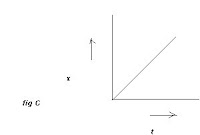

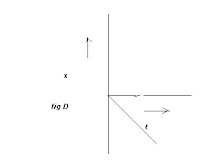
a. a and c only
b all the four
c. b and D only
d. b only
6. What all graph shows motion with negative velocities
a. b and d only
b all the four
c. a and c only
d. c only
7.which of the folliwing graph correctly represents velocity-time relationships for a particle released from rest to fall under gravity
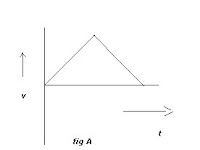

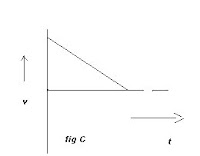

8.The v-x graph(fig1) of a particle moving along a straight line is shown below.Which of the following below graph(A,B,C,D) shows a-x graph


Solutions


2. The displacement -time graph of a moving particle is shown below.The instantanous velocity of the particle is negative at the point

a. C
b. D
c. B
d. A
3.The velocity -time graph of a moving particle is shown below.Total displacement of the particle during the time interval when there is nonzero acceleration and retardation is

a. 60m
b. 40m
c. 50m
d. 30m
4. Figure below shows the displacement -time graph of two particles.Mark the correct statement about their relative velocity

a. It first increases and then decreases
b. It is a non zero constant
c. it is zero
d. none of the above
5.Four position -time graph are shown below.What all graph shows motion with positive velocities


a. a and c only
b all the four
c. b and D only
d. b only
6. What all graph shows motion with negative velocities
a. b and d only
b all the four
c. a and c only
d. c only
7.which of the folliwing graph correctly represents velocity-time relationships for a particle released from rest to fall under gravity


8.The v-x graph(fig1) of a particle moving along a straight line is shown below.Which of the following below graph(A,B,C,D) shows a-x graph


Solutions
Thursday, 6 March 2008
Kinematics Numerical
1. A boy is standing at a distance a1 from the foot of a tower.The boy throws an stone at a angle 45° which just touches the top of the tower and strikes the ground at a distance a2 from the point the boy is standing.Find the height of the tower
2. A ball is thrown upward from a point on the side of a hill which slopes upward uniformly at angle 45°.Intial velocty of the ball is u0 m/s and at an angle 65°(with respect to the horizotal).At what distance up the slope the ball strike and in what time?
3.A cannon on a level plain is aimed at an angle θ above the horizontal.A shell is fired with a muzzle velocity v0 towards a pole which is distance R away.It hits the pole at height H.
a find the timetaken to reach the pole
b. find the value of H in terms of θ,R and v0
4. The displacement of the body x(in meters) varies with time t (in sec) as
x=(-2/3)t2 +16t+2
find following
a. what is the velocty at t=0,t=1
b. what is the acceleration at t=0
c. what is the displacement at t=0
d .what will the displacement when it comes to rest
e .How much time it take to come to rest.
5. A man runs at a speed at 4 m/s to overtake a standing bus.When he is 6 m behind the door at t=0,the bus moves forward and continues with constant acceleration of 1.2 m/s2
find the following
a. how long does it take for the man to gain the door
b if in the beginning he is 10m behind the door ,will he running at the same speed ever catch up bus?
Detailed Solutions:
3. The time taken to reach the pole is given
R=v0cosθ t
or t=R/v0cosθ
Now equation of motion of vertical motion
h=v0sinθt-1/2gt2
at t=R/v0cosθ h=H
so
H=(v0sinθ)X(R/v0cosθ ) -(1/2)g( R/v0cosθ)2
or H=Rtanθ-gR2/2v02cos2θ
4.
Given x=(-2/3)t2 +16t+2
Velocity=dx/dt=(-4/3)t+16
so velocity at t=0 =16
and velocity at t=1 =(-4/3)+16=44/3
Acceleration is given as =d2x/dt2=-4/3
so acceleration is time independent and it is constant
Displacement at t=0 can be found by simply substituting the values of t=0 in equation (1)
=2
Now v=(-4/3)t+16
when v=0
then t=4/3 sec
Displacement can be found by substituing the value of t=4/3 in equation (1)
=-32/27+64/3+2
=(-32+576+54)/27=598/27 m
Wednesday, 5 March 2008
Objective question for Kinematics
1. A body is projected horizontally from a point above the ground.The motion of body is defined as
x=2t
y=2t2
where x and y are horizontal and vertical displacement respectivley at time t.Which one of the following is true
a.The trajectory of the body is a parabola
b The trajectory of the body is a straight line
c.the velocity vector at point t is 2i+4tj
d the acceleration vector at time t is 4j
2.when the projectile is at the highest point of its trajectory,the direction of its velocity and acceleration are
a. parallel to each other
b.antiparallel to each other
c. Inclined to each other at 45
d. Perpendicular to each other
3.The horizontal and vertical displacement of the projectile at time t are
x=36t
y=48t-4.9t2
where x and y are in meters and t in second.Intial velocity of the projectile in m/s
a. 15
c. 30
b. 45
d. 60
4.Displacement(y) of the particle is given by
y=2t+t2-2t2
The velocity of the particle when acceleration is zero is given by
a. 5/2
b. 9/4
c. 13/6
d. 17/8
5. A car ,starting from rest is accelerated at constant rate a until it attains speed V.It is then retarted at a constant rate b until it comes to rest.which of the following is true
a. the average speed for the whole motion is av/2b
b. the average speed for the whole motion is v/2
c. Total time taken for the journey is v(1/a+1/b)
d. none of the above
6.The intial velocty of the particle is u=4i+3j m/s.It is moving with uniform acceleration a=.4i+.3j m/s2.which of the following is true
a. the magnitude of the velocity after 10 sec is 10m/s
b. The velocity vector at time t is given by (4+.4t)i +(3+.3t)j
c. the displacement at time t is (4t+.22)i +(3t+.152)j
d . none of the above
7.It is possible to project an body with a given speed in two possible ways so that it has a same horizontal range.The product of time taken by it in tow possible ways is
a. R/g
b. 2R/g
c. 3R/g
d. 4R/g
8.A projectile has a range R and time of flight T.If the range is tripled by the increasing the speed of the projection ,without changing the angle of projection.The time of the flight will become
a T/√3
b T√3
c. T/3
d. 3T
9.A large number of stones are fired in all the direction with same speed V.The maximum area of the ground on which this stone will spread is
a. πV4/g2
b. π2V4/g2
c. πV4/g
d. πV/g2
10.A body is projected horizontally from the top of the building 39.2 m high.How long will it take to hit the ground
a. 2 sec
b. 4 sec
c. 1 sec
d 2√2 sec
Detailed Solutions
Ans 4:
given
y=2t+t2-2t3
Velocity is given
v=dy/dt=2+2t-6t2
a=dv/dt=2-12t
Now acceleratio is zero
2-12t=0
t=1/6
Putting this value velocity equation
v=2+2/6-6(1/6)2
=2+1/3-1/6
=13/6
Ans 5:
The distance s1 covered by the car during the time it is accelerated is given by
2as1=v2
Which gives
s1=v2/2a
Similary in the decelerated motion,distance covered is
2bs2=v2
Which gives
s2=v2/2b
SO Total distance travelled during the whole journey
s=s1+s2=v2/2(1/a+1/b)
Let t1 be the time taken during accelerated motion then
v=at1 or t1=v/a
and Let t2 be the time taken during deccelerated motion then
v=bt2 or t2=v/b
Total timetaken
t=t1+t2
=v(1/a+1/b)
So average speed =total distance/total time taken
=s/t=v/2
Ans 7:
If a body is projected with a given velocity u at angle θ and (90-θ) to the horizontal,it will have same range R given by
R=u2sin2θ/g
The corresponding times if flight are
t1=2usinθ/g
t2=2usin(90-θ)/g=2ucosθ/g
t1t2=2u2(2sinθcosθ)/g2
=2u2sin2θ/g2=2R/g
Ans 8
Range is given by
R=u2sin2θ/g-----(1)
and time taken by
T=2usinθ/g-----(2)
Now
3R=uc2sin2θ/g-----(3)
Tc=2ucsinθ/g-----(4)
Dividing 1 by 3
1/3=(u/uc)2 ----5
Dividing 2 by 4
T/Tc=u/uc ---6
From 5 and 6
T/Tc=1/√3
Tc=T/√3
Ans 10:
Intial vertical component of velocity is zero
so h=(1/2)gt2
39.2=(1/2)*9.8*t2
t=2√2 sec
Monday, 3 March 2008
Short notes in Motion in a plane
Short notes for motion in one dimension
i,j,z are the unit vector along x,y and z axis
Notes: Bold letter are used to denote vector quantity
r=xi
v=(dx/dt)i
a=dv/dt=(d2x/dt2)i
a=vdv/dr
v=u+at
s=ut+1/2at2
v2=u2+2as
r=∫vdt
v=∫adt
Short notes for motion in two dimension
r=xi +yj
v=dr/dt=(dx/dt)i + (dy/dt)j
a=dv/dt=(d2x/dt2)i+(d2x/dt2)j
a=vdv/dr
v=u+at
s=ut+1/2at2
v2=u2+2as
r=∫vdt
v=∫adt
Short notes for motion in three dimension
r=xi +yj+zk
v=dr/dt=(dx/dt)i + (dy/dt)j+(dz/dt)k
a=dv/dt=(d2x/dt2)i+(d2x/dt2)j+(d2x/dt2)k
a=vdv/dr
v=u+at
s=ut+1/2at2
v2=u2+2as
r=∫vdt
v=∫adt
Subscribe to:
Posts (Atom)